Written by the CSCmotion Motion Control Engineering Team
Published: October 24, 2026 · Updated: October 24, 2026
Review scope: shipment planning, buyer and supplier responsibilities, document requests and installation handover.
Importing a custom industrial motion platform begins before freight is booked. The buyer needs to connect the equipment configuration, packing arrangement, transport contract, destination requirements and installation plan. A shipment can arrive at a port while the laboratory is still unprepared to receive or commission it.
Start with a shared definition of what will be delivered and who owns each handoff. The supplier, forwarder, destination broker, receiving team and installation team may be different organizations. Assign the work between them before treating a transport quotation as a complete delivery plan.
CSCmotion is based in Nanjing, China, and supplies custom electric motion platforms. Sea, air and rail shipment can be discussed, including shipment through your nominated forwarder, with the quotation based on the Incoterm you specify. The actual route, responsibilities and documents still need confirmation for the project and destination.
What Ships, in How Many Crates
Start with the supply list accepted by the purchasing and engineering teams. Keep the hardware list for the motion system in the project file, including the base and control equipment, and distinguish it from the customer’s moving payload. Identify the platform, control cabinet, controller and other items included in the project. Record separately anything the buyer or integrator provides. A cockpit, host system or test fixture should not appear in the receiving plan merely because it is shown in an application illustration.
All CSCmotion platforms are custom, engineered around the customer’s load, stroke, speed and acceleration requirements. Confirm crate count, dimensions and shipment weight for the actual configuration before planning freight and site access.
Distinguish the equipment’s operating footprint from its packed envelope. The receiving team needs the packed dimensions to review doors, access routes and unloading arrangements. The engineering team needs the installed footprint and clearance for operation and maintenance. Keep both sets of information attached to the same configuration revision.
Ask for a packing arrangement that connects each package to the supply list. It should be possible to identify which crate contains the controller or other separately packed equipment without opening every package. Confirm what needs to remain together during onward transport and which items are needed first during installation.
CSCmotion platforms ship in export wooden crates with the moving parts locked. Review crate dimensions, handling instructions and destination packaging requirements for the shipment being planned.
Use the supplier’s handling information to plan movement of the packed equipment. The receiving contractor should establish the suitable lifting equipment and method from the actual package data. Do not infer lifting points, the center of gravity or permissible handling from the outline of a crate. If a crane or other lifting equipment is required, arrange it through the responsible qualified team.
Before finalizing the transport booking, compare the packing information with the commercial supply list and the receiving site’s restrictions. A change in configuration can affect more than the machinery specification: it may require a new review of access, handling and freight arrangements. Our export crating and shipping page provides the company delivery context; the project documents define the actual consignment.
Sea, Air or Rail: How to Choose
Ask the forwarder to evaluate routes using the final packed dimensions, gross weight, destination and required delivery milestone. Transport mode should be selected for a complete journey, including origin collection and destination handling. The main international leg is only part of the movement from factory to installation site.
Compare the assumptions behind each proposed route. Confirm the handover locations, transfers, handling arrangements, documentation requirements and onward delivery responsibilities. A route described as faster may still depend on destination release, local access and a receiving appointment that have not yet been arranged.
Scroll horizontally to view all columns →
| Mode to discuss | Situation to evaluate | Timing questions to ask | Handling and delivery questions |
|---|---|---|---|
| Sea | Whether the packed platform and destination arrangements fit the proposed sea service | Which booking, departure, transfer and arrival milestones remain provisional? | What loading arrangement, destination handling and onward transport are included? |
| Air | Whether the packed cargo is acceptable to the proposed service and the project requires this routing | When is cargo acceptance confirmed, and what connections or release steps affect arrival? | Are the package dimensions and handling needs accepted throughout the route? |
| Rail | Whether a suitable service and connected route are available for the destination | Which border, terminal and transfer stages must be included in the schedule? | Who arranges terminal handling and the road legs to and from the rail service? |
Obtain the current service proposal from the forwarder and record which booking milestones the carrier has accepted. Review changes before coordinating installation personnel or access to a laboratory that may have limited receiving windows.
CSCmotion can work with your nominated forwarder. Provide the forwarder’s contact details and identify who is authorized to coordinate collection. Confirm how packing data, document questions and changes will be communicated. Record the transport and destination tasks assigned to the buyer, seller and forwarder.
Keep the mode decision separate from the Incoterm decision. One addresses how the goods move; the other helps define responsibilities under the sale contract. The forwarder and purchasing team should review them together so that the booking instructions match the commercial arrangement in the purchase contract.
If the project schedule changes, revisit both transport and site readiness. An earlier arrival is useful only when import arrangements, unloading and storage are ready. A later installation may require a documented storage plan. Ask the supplier for the applicable storage instructions rather than assuming that an unopened export crate can remain anywhere indefinitely.
Incoterms Explained for Machinery Buyers
Incoterms rules allocate specified responsibilities, risks and costs between buyer and seller. The ICC’s official explanation of Incoterms 2020 is the starting reference. For a machinery purchase, review the selected rule with the actual named place and the corresponding contract responsibilities.
Do not leave the destination as a broad country name when the handover location needs to be precise. Identify the port, terminal, address or other named place relevant to the chosen rule. Then confirm who arranges each movement before and after that point. The receiving team’s understanding should match the purchasing team’s wording.
A useful contract discussion separates carriage, risk, insurance, customs formalities and unloading. Ask who owns each task and where the responsibility changes. Avoid assuming that payment for one part of transport means the same party carries every risk or handles every destination requirement.
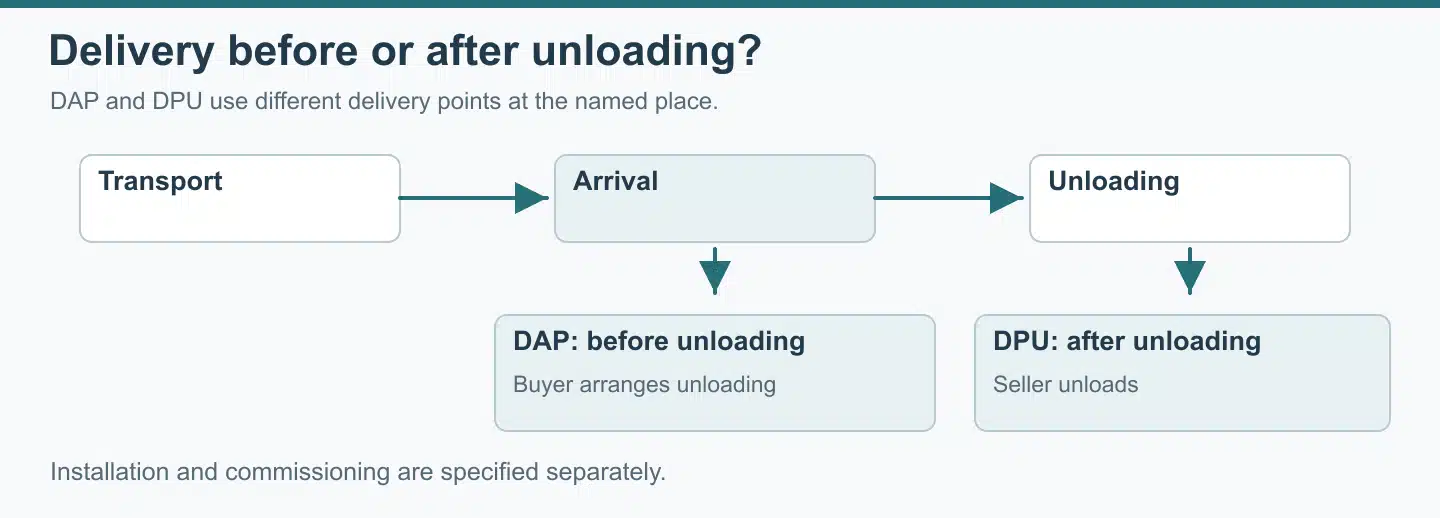
The distinction between DAP and DPU illustrates why unloading deserves explicit attention. ICC explains that delivery under DAP takes place before unloading, while DPU includes unloading by the seller. That difference can materially affect the receiving plan for machinery.
After selecting a rule, document the work that still falls outside the transport handover. Assign positioning, connection, host integration and commissioning separately from transport delivery. The installation team and buyer should define the commissioning scope and readiness conditions separately.
Ask the destination broker to review the proposed import arrangement before the order is finalized. Identify the importing party and the party responsible for the required destination formalities. Do not wait until cargo is moving to discover that a responsibility assumed by one team has not been accepted by another.
Insurance also deserves an explicit discussion. Ask who arranges it, what journey and risks it covers, and what information is required if damage is observed. Keep the applicable policy and notification instructions with the shipment records. Review the policy coverage and notification requirements with the party arranging insurance.
CSCmotion quotes on the Incoterm you specify. Provide the destination and intended responsibility split so that the quotation can be reviewed against the actual project. The accepted quotation and contract must identify who performs each task.
For the technical and commercial inputs that precede this discussion, review what to agree before you sign. Keep the equipment scope, acceptance conditions and transport terms consistent across the purchase documents.
Customs and Documents to Request from Any Supplier
Build the document request with the destination importer, broker and forwarder. A general list can organize the conversation, but the final requirements depend on the destination, goods and transaction. The official guidance on common export documents identifies the main document categories and recommends consulting the importing party or forwarder about the required set.
The following are documents to discuss with any machinery supplier. Confirm the applicable documents and the supplier’s commitment in the quotation; requirements differ by destination and shipment.
Scroll horizontally to view all columns →
| Document or record | Purpose to confirm | Question for the responsible party |
|---|---|---|
| Commercial invoice | Identify the goods and transaction for the relevant formalities | What details and format does the destination require? |
| Packing list | Match package contents, identifiers, dimensions and weight | Does it reconcile with the actual consignment? |
| Transport document | Identify the shipment and applicable transport arrangement | Who issues it and manages release instructions? |
| Origin evidence, when required | Address the destination’s applicable origin requirement | What form is needed and who arranges it? |
| Destination-specific documents | Address requirements identified for this equipment and shipment | What must be confirmed before the quotation is accepted? |
Arrange a review of draft details before shipment where practical. Check company names, addresses, item descriptions and package references against the supply list in the purchase contract. A correction made in one document should be reviewed for its effect on the others. Give the forwarder and broker the same current document set and identify its revision.
Wood packaging is a separate destination question. For example, U.S. APHIS guidance describes requirements for regulated wood packaging and distinguishes alternative materials. Have the relevant party check the actual material and destination requirements.
For CSCmotion, compliance documents are agreed according to the project and destination requirements. Confirm the export-document list with the supplier during quotation according to the project and destination requirements.
Keep technical handover documents separate from customs paperwork. Sample FAT protocols and interface documents can be supplied before an order for review. Have the project engineer specify the final technical records, operating information and document languages needed for the project. The broker’s import checklist and the engineer’s commissioning checklist serve different purposes and should both have owners.
Do not ask the platform supplier to guess the destination requirements from a short product name. Provide the intended use and configuration to the responsible importing professionals so they can advise on the applicable process.
From Port to Lab: Unpacking, Installation and Commissioning
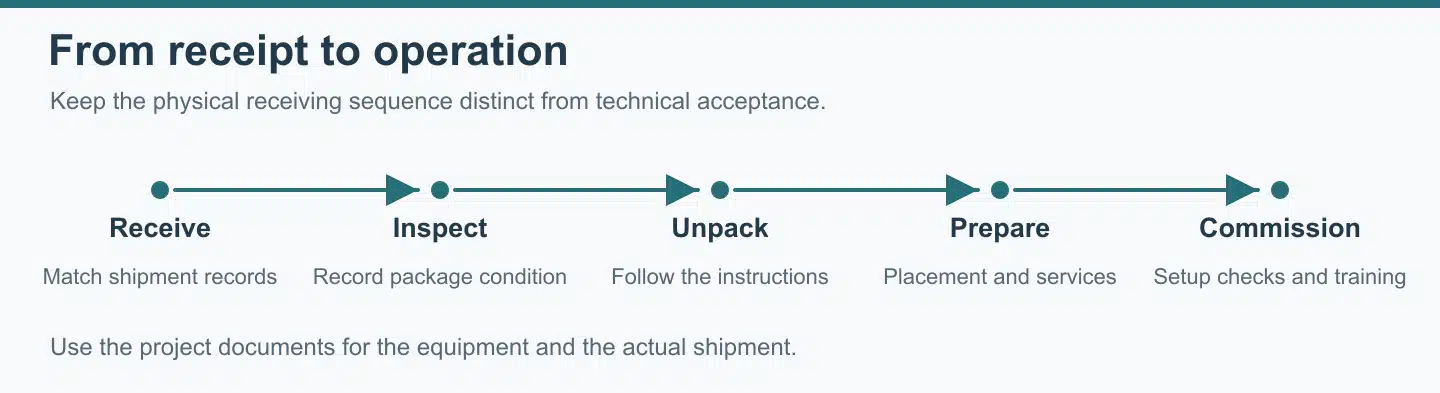
Work backward from the final installation location. Confirm the route from the receiving point to the room, including doors, turns, floor conditions and space to handle the packages. The packed cargo must fit the receiving route; the installed system also needs the working and maintenance space defined in the project documents.
Appoint a site owner who can coordinate the broker, local carrier and handling contractor. Give that person the current packing data, receiving contact details and supplier instructions. Avoid arranging delivery around an assumed unloading method that the carrier or site contractor has not accepted.
At receipt, identify the packages and compare them with the shipment records. Follow the inspection and notification procedure in the shipment instructions if damage or a discrepancy is found. Preserve the relevant photographs and records, and contact the responsible parties before making changes that could complicate assessment of the condition received.
Unpacking should follow the supplier’s instructions for the actual equipment. Moving-part locks are part of the transport arrangement. Their release belongs in the documented installation sequence, with the appropriate support and setup conditions in place. Do not remove restraints or energize the platform simply because the exterior packaging has been opened.
Coordinate mechanical placement, electrical preparation and host integration as related tasks. The controller, services, mounting arrangement and surrounding equipment must be prepared according to the project documentation and the commissioning scope defined in the contract.
Installation and commissioning, from remote guidance to on-site work, are agreed for each CSCmotion project. Confirm the scope, site responsibilities and prerequisites before scheduling the work. If the project uses remote guidance, identify the local personnel who will perform the required tasks and the information they need to provide during the session.
The commissioning team should define the observations and records before the first session. Identify the configuration, load and motion conditions used, and separate equipment checks from the customer’s wider application tests.
CSCmotion provides operation and maintenance training, remote support and spare parts directly. Each platform carries a twelve-month warranty. Keep the agreed warranty terms and service arrangements with the handover records rather than assuming details about travel, freight, local work or response arrangements that have not been specified in the contract.
For research motion platforms, appoint a laboratory owner for the operating records and approved configuration. Control software can be upgraded or frozen at an agreed version. Record which version was used at acceptance so that later software changes can be assessed against the same baseline.
Common Delays and How to Avoid Them
Look for unresolved handoffs before focusing only on the transport schedule. A project can lose time because packing data are provisional, the named place is unclear, documents have inconsistent details or site preparation is incomplete. Assign an owner to each open item while there is still time to resolve it before dispatch.
Scroll horizontally to view all columns →
| Open issue | Action before the next handoff | Owner to appoint |
|---|---|---|
| Equipment configuration changes after freight planning | Reconfirm packed dimensions, weight and handling assumptions | Supplier and forwarder |
| Import requirements remain unclear | Obtain destination-specific advice and confirm the document request | Importing party and broker |
| Contract and transport instructions use different handover points | Align the named place and responsibility split | Purchasing team and forwarder |
| The room or access route is unprepared | Confirm route, services and handling arrangements | Site owner |
| Commissioning is booked before required inputs are ready | Review prerequisites and identify missing items | Project engineer and installation team |
| Different teams hold different document versions | Issue a controlled current set and retire superseded copies | Project document owner |
Ask the responsible party to identify the next decision and the evidence needed to close it. A vague status such as “shipping arranged” is less useful than knowing which booking, documents and receiving arrangements are actually confirmed.
Keep manufacturing lead time, transport milestones and commissioning readiness separate in the project schedule. Each depends on different work and may have a different owner. Report changes against the affected milestone instead of treating all stages as a single delivery date with no assumptions attached.
Factory acceptance testing should also be coordinated with dispatch planning. FAT can be witnessed on site or by remote video under the project agreement. Confirm the required observations and records before deciding that the shipment is ready for its next handoff. Record logistics readiness and technical acceptance as separate decisions with their own owners and supporting documents.
If you are still comparing suppliers, use the motion platform manufacturer selection criteria to examine scope and evidence before comparing delivery arrangements.
For 6DOF motion platforms or Stewart platforms, send the application, moving load, required motion and destination together. That connects the technical configuration to the packing and transport discussion from the start.
Ask for a quotation to your Incoterm. Include the named place, nominated forwarder if applicable, and the destination requirements already identified. CSCmotion offers a free feasibility review and quotation; unresolved documents and responsibilities should be confirmed before the order proceeds.
FAQ
Can we use our own freight forwarder?
Yes. CSCmotion can ship through your nominated forwarder. Provide the contact details and appoint a coordinator for collection, document questions and changes. The forwarder’s appointment should be consistent with the selected Incoterm and the responsibilities in the purchase contract.
How many crates will the platform arrive in?
The count depends on the ordered configuration and packing arrangement. Ask for the package list, dimensions and weight for your order. Do not use another platform’s shipment as the basis for booking freight or planning access to your site.
Does an export wooden crate guarantee destination acceptance?
No. Confirm the destination requirements for the actual packaging material with the responsible importer, broker and supplier. CSCmotion platforms ship in export wooden crates with the moving parts locked.
Does CSCmotion handle customs clearance for every shipment?
Arrange destination clearance with the importing team and broker. Define the importing party, destination formalities and related responsibilities in the quotation and contract.
Are installation and commissioning included automatically?
Their scope is agreed for each project, from remote guidance to on-site work. Confirm the site prerequisites, work allocation and acceptance plan before scheduling. Use those prerequisites and the acceptance plan to set the installation and commissioning schedule.
References
- ICC: Incoterms 2020, for the role of the rules and the unloading distinction discussed above.
- Common export documents, for general document categories; the destination-specific set still requires confirmation.
- APHIS: importing wood packaging, for the U.S. example of packaging requirements and material distinctions.
Discuss your project with CSCmotion. Share your application, moving load and required motion for a free feasibility review and quotation.