Written by the CSCmotion Motion Control Engineering Team
Published: October 24, 2026 · Updated: October 24, 2026
Review scope: supplier comparison, platform scope, evidence requirements and procurement handover.
The most useful motion platform manufacturer selection criteria connect your project requirements to three things: the proposed configuration, the evidence behind it, and the party responsible for delivery. A product description can start a conversation. Ask the supplier to connect each answer to the proposed equipment and delivery scope.
If you already have several suppliers on your shortlist, give them the same project information before comparing their replies. Then record each answer, the document supporting it, and the questions still open. This makes differences visible without turning an incomplete proposal into a misleading score.
Use an eight-criterion comparison to connect each supplier’s answer to a document, an owner and an unresolved decision. It focuses on choosing a supplier for a complete motion platform. Detailed platform sizing belongs in the engineering review; the task here is deciding which supplier can explain its proposed scope and how that scope will be verified.
What to Settle Before You Compare Manufacturers
Establish one version of the application requirement and send it to every candidate. Differences in the input package can make two reasonable proposals appear inconsistent.
Describe what moves, what it is attached to, and what the motion must achieve. For industrial research, that may mean a specimen and fixture on a test rig. For a vehicle simulator or civil flight training project, identify the cockpit, equipment and occupant assumptions included in the moving load. Explain the training objective or motion simulation task without assuming the platform supplier owns the surrounding simulation system.
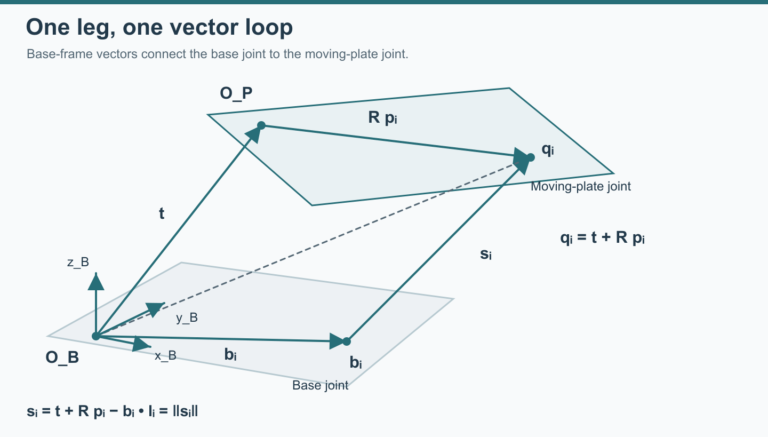
Give mass, mounting geometry, center of gravity and orientation a common reference. Where rotational dynamics require inertia data, identify the reference point and coordinate axes. Inertia depends on mass distribution and reference definitions; a value detached from those definitions is incomplete input. The MIT lecture listed below explains this distinction. Keep the requested center of rotation distinct from the load’s center of gravity.
Also distinguish separate movements from a combined trajectory. A table of individual axis limits does not establish that those limits are available together. Ask for the relevant workspace and load evaluation at your required positions, rotation reference and installation orientation. Ask each candidate to evaluate the same combination.
Identify the evidence needed to resolve each assumption. In a hypothetical comparison, one supplier might include the mounting fixture in the load while another excludes it. Resolve that difference before comparing their conclusions.
Use the motion platform selection checklist to prepare the detailed inputs. For this comparison, retain the document revision and ask suppliers to identify any departures from it in their response.
Four Types of Motion Platform Suppliers (and What Each Actually Builds)
Compare the work each supplier will perform, even when companies use similar product names. Use these four roles to compare procurement responsibilities. A business may cover several roles on the same project.
Scroll horizontally to view all columns →
| Supplier role | Scope to establish | Question that clarifies responsibility |
|---|---|---|
| Complete platform manufacturer | Mechanical design, platform assembly, drives, controls and final platform testing | Which activities do you perform, and who is responsible for the assembled platform’s agreed requirements? |
| System integrator | Connection of a platform with host software, application equipment and the wider system | Which platform responsibilities remain with its manufacturer, and which integration work do you own? |
| Component assembler | Selection and assembly of constituent hardware and software into a platform | Who evaluates the assembled configuration and resolves interactions between its components? |
| Precision positioning manufacturer | Platforms designed around positioning, alignment or holding tasks | Does the proposed product address our actual motion task and evaluation method? |
The category is the start of an interview. An integrator may provide valuable application knowledge; a complete platform manufacturer may still require your team to handle host integration. Record the responsibility split in the proposal.
Ask what “manufacturing” means for the offered configuration. Does it include mechanical structure design, actuator assembly, electrical assembly, control software or commissioning? Request a named owner for each activity that matters to your project. A factory photograph or a long component list leaves those questions unanswered.
Likewise, establish whether the offer is an off-the-shelf standard model, a standard platform with modifications, or a custom design. Customization may change mounting interfaces, geometry or documentation. Ask which changes are included and which require a fresh review.
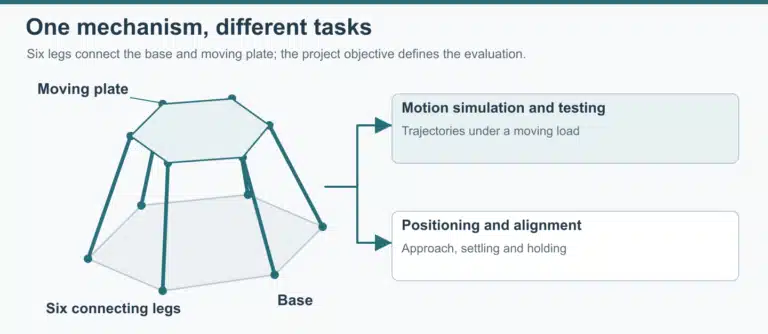
The same approach applies when comparing 3DOF, 6DOF or hexapod suppliers. Ask the supplier to identify who owns the engineering work for the proposed mechanism and drive arrangement. Use the role table to obtain a responsibility statement, then carry that statement into the evidence worksheet.
Eight Criteria for Comparing Manufacturers on the Same Project
Compare answers against the same requirements and record their supporting material. Weight the following criteria according to your project priorities. Your team must decide which unresolved items prevent further evaluation.
1. Responsibility for the complete platform
Identify the party responsible for the assembled equipment and its agreed scope. Ask who develops the mechanical design, selects the drive arrangement, supplies the control cabinet and resolves issues involving several teams.
For a proposed electric platform, distinguish a statement about linear actuator technology from responsibility for the complete machine. A servo component specification is one piece of the design record. Ask how the supplier relates it to the configuration being offered.
When reviewing 6DOF motion platforms or Stewart platforms, obtain the same responsibility breakdown. Product names help locate candidates; a documented scope identifies what you would receive and who would address an unresolved requirement.
2. The basis for load and motion evaluation
Ask what the payload capacity or load rating refers to. Does the evaluated mass include the fixture and every moving attachment? Which center of gravity, mounting direction and platform position were assumed?
For a dynamic load, request an explanation of how the proposed motion was included in the review. Where relevant, identify external force, torque and the supplier’s basis for actuator loading. Keep any proposed payload margin tied to a stated operating condition; a margin without its assumptions is difficult to compare.
A useful response identifies the input revision, assessment scope and missing information. It may reasonably require more data. Record that request as an open point rather than treating an unanswered field as zero capability. Static support and the ability to execute your intended trajectory are different questions for the supplier to address.
3. The operating envelope and duty cycle
Request a motion envelope for the task you supplied. Separate linear travel range from angular travel, and ask whether surge, sway, heave, roll, pitch and yaw are assessed individually or in the required combination. Ask the supplier to explain how actuator stroke maps to platform displacement and motion range in the proposed configuration.
Treat speed and acceleration in the same way. Ask which load, orientation and motion profile apply to a velocity limit or dynamic performance statement. Distinguish peak operation from continuous operation and describe the expected duty cycle.
If vibration, structural stiffness, temperature or thermal behavior matters to your application, ask for the relevant evaluation method and conditions. Do not fill those fields with generic adjectives. A service life estimate likewise needs its operating assumptions and scope.
For industrial testing platforms, agree what motion performance the test requires and where dynamic response will be evaluated.
4. Control architecture and interface ownership
Ask for a diagram of the control architecture and an interface document applicable to the proposed version. Establish what the host software sends, what the motion control system returns, and which party develops and maintains each connection.
Request the relevant command definitions, feedback, communication protocol and error handling information. If timing matters, ask how update rate and control latency are defined and evaluated across the intended connection. Evaluate controller timing and the complete host-to-platform response separately.
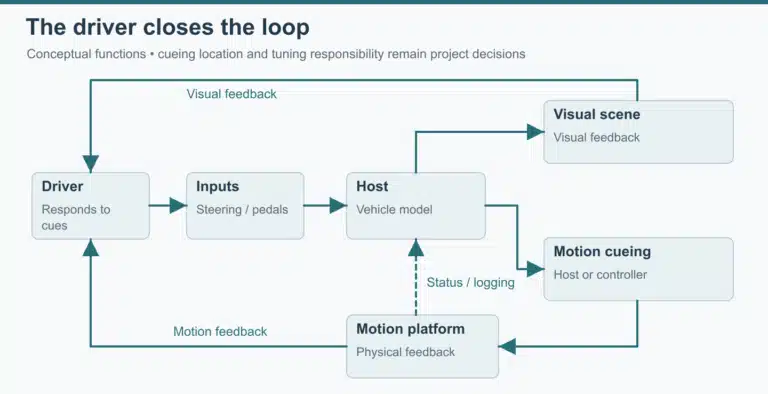
For a simulator, establish who owns motion cueing, the cueing algorithm and its tuning. Ask how the cueing strategy relates to the visual system and training task. Distinguish this coordination work from servo control within the platform. The comparison should show who supplies, integrates and verifies each part, without assuming that one supplier covers the entire simulator architecture.
5. Configuration and supporting records
Tie each specification to an identifiable model and configuration revision. Ask whether the supplied documentation covers the mechanical structure, control software and hardware actually proposed. A sample document can explain the format while leaving project values undecided.
For performance data, request the conditions and status of the record. Is a curve calculated, measured on another configuration, or obtained from the proposed assembly? Which requirement does it address? An illustrative reference should remain labeled as such.
Record changes when a mounting layout or software version is revised. Then ask the supplier which earlier conclusions remain applicable. Keep a traceable connection between the offer and its supporting evidence. Keep obsolete revisions available for comparison but clearly identify the current basis.
6. Acceptance criteria and verification
Agree what acceptance testing is intended to demonstrate. Identify the test load, trajectory, method and acceptance criteria before treating a demonstration as proof of a requirement. Ask who reviews the results and records unresolved items.
Factory testing, a factory acceptance testing plan, an executed test record and customer acceptance describe different states. A supplier’s proposed protocol shows how work is planned. A completed record should identify what was tested, under which conditions, and the observed result. Record the acceptance decision against the agreed criteria and test results.
Keep inspection, safety responsibilities, compliance documentation and any project qualification requirements explicit. Ask what a certification statement covers instead of assuming it verifies motion behavior. Where stability or motion error is relevant, have the project team define the required evaluation; record the limits and test procedure in the project agreement.
7. Installation and integration handover
Request an installation interface drawing and a responsibility list. Identify the platform footprint, required clearance, floor interface and electrical needs for review against your facility constraints. Record environmental conditions that the supplier must assess.
Discuss cable management and the position of the cabinet, host computer and other application equipment. These questions concern the supplied arrangement; do not assume a published layout represents your installation.
For delivery and commissioning, specify who prepares the site, who performs the integration work and what integration support is included. Ask what the operator needs at handover and which training belongs to the platform package. Keep this scope distinct from training on your application. A named handover owner helps your team identify unfinished work before scheduling installation activities.
8. Regional Service and Support
Ask how maintenance, troubleshooting and repair would be handled for your configuration and destination. Identify the technical support contact, the information needed to diagnose a problem, and the process for obtaining a spare or replacement item.
If lifecycle support affects the acquisition decision, ask about software upgrades, version retention and any refurbishment option. Availability and service terms should be recorded against the actual proposal.
Treat domestic manufacturing and support location as separate entries. Ask how support responsiveness is defined and what happens when remote guidance is insufficient. Assess possible downtime and schedule risk using the proposed support arrangements.
For a USA-based project, confirm where design, assembly and support are provided and how site work or replacement parts would be arranged. CSCmotion is based in Nanjing, China. Support, site work and replacement-parts arrangements should be agreed for the project and destination. Specify the destination and agree support responsibilities in the project proposal.
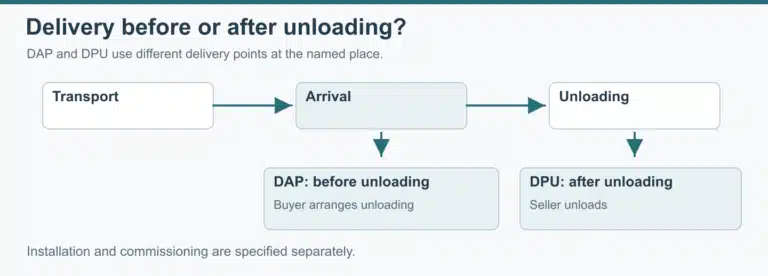
For international handover, review importing a motion platform from China before assigning freight, unloading and commissioning tasks.
Copy this table and replace the blanks with document names and revisions, responsible parties and open points. Add candidates as needed. For each “Unknown,” record the clarification needed and the person responsible for obtaining it.
Scroll horizontally to view all columns →
| Criterion | Evidence requested | Candidate A | Candidate B |
|---|---|---|---|
| 1. Complete platform responsibility | Scope and responsibility statement | Document/version: ___; project lead: ___; open point: ___ | Document/version: ___; project lead: ___; open point: ___ |
| 2. Load and motion basis | Input revision, assumptions and assessment scope | Document/version: ___; load analyst: ___; open point: ___ | Document/version: ___; load analyst: ___; open point: ___ |
| 3. Envelope and operating cycle | Required combination, limits and duty conditions | Document/version: ___; motion engineer: ___; open point: ___ | Document/version: ___; motion engineer: ___; open point: ___ |
| 4. Controls and interface | Architecture, applicable interface version and integration owner | Document/version: ___; controls engineer: ___; open point: ___ | Document/version: ___; controls engineer: ___; open point: ___ |
| 5. Configuration records | Current specification and evidence applicability | Document/version: ___; document lead: ___; open point: ___ | Document/version: ___; document lead: ___; open point: ___ |
| 6. Acceptance | Proposed conditions, method, criteria and result status | Document/version: ___; test lead: ___; open point: ___ | Document/version: ___; test lead: ___; open point: ___ |
| 7. Handover | Site inputs, commissioning responsibilities and training scope | Document/version: ___; handover lead: ___; open point: ___ | Document/version: ___; handover lead: ___; open point: ___ |
| 8. Support | Maintenance, software and destination-specific support arrangements | Document/version: ___; service contact: ___; open point: ___ | Document/version: ___; service contact: ___; open point: ___ |
Use the completed worksheet to choose the next engineering discussion. Close the items that could change the proposed configuration or contract scope before making a final selection.
Questions to Ask Before You Request Quotes
Ask a small set of questions that makes the proposal comparable. Your detailed input package supplies the technical information; this conversation establishes what the supplier will do with it.
- Which revision of our requirements will your proposal address, and which assumptions need confirmation?
- What is included in the platform package, and which integration responsibilities remain with our team?
- Which requirements need further engineering evaluation before you can confirm a configuration?
- What documents can you share now, and which will be developed for the project?
- What decisions or missing inputs could change the scope or delivery schedule?
Send these questions with the same attachments to each candidate. Ask for exceptions in a single reply so that a procurement reviewer can assess the complete scope in one place.
Keep technical uncertainty separate from commercial negotiation. A proposal based on an unconfirmed fixture or host interface needs clarification even if its acquisition terms fit your budget. Conversely, a request for additional information can be a useful engineering response rather than a reason to eliminate a supplier.
Record any trade-off the supplier proposes, who must approve it, and what evidence is needed. Discuss the cost of additional integration work only after its responsibility is clear. The comparison becomes useful when both proposals describe the same deliverable and identify the work still needed.
Red Flags in Quotations and Datasheets
A red flag is a reason to ask for clarification.
A maximum without conditions. A motion range, payload statement or speed rating needs the applicable configuration and operating conditions. Ask which load and movement combination it covers. Request an explicit answer when a catalog lists separate axis limits but your task combines them.
A demonstration presented as a complete test. Ask what the demonstration was intended to establish and which requirements remain unverified. Compare the conditions, method and recorded result for the requirement shown in the video.
Documents that refer to different versions. In a hypothetical example, the proposal includes one control software version while the interface sample describes another. Do not assume equivalence or incompatibility. Ask for a documented applicability statement and keep the difference open until clarified.
An unassigned responsibility. If both suppliers in a joint arrangement say the other party handles host integration, record the missing owner. Request a coordinated scope before treating the integration plan as complete.
An unchanged conclusion after changed inputs. A revised fixture, different load position or new motion profile may require review. Ask what was rechecked and what remains valid. The response should make the reasoning inspectable, even when the final configuration stays the same.
For each signal, record the question, the requested material and the next decision. An honest limitation can be more useful than a broad assurance with no identifiable basis. Keep uncertainty visible until the responsible team has enough evidence to resolve it.
How CSCmotion Approaches a Custom Platform Project
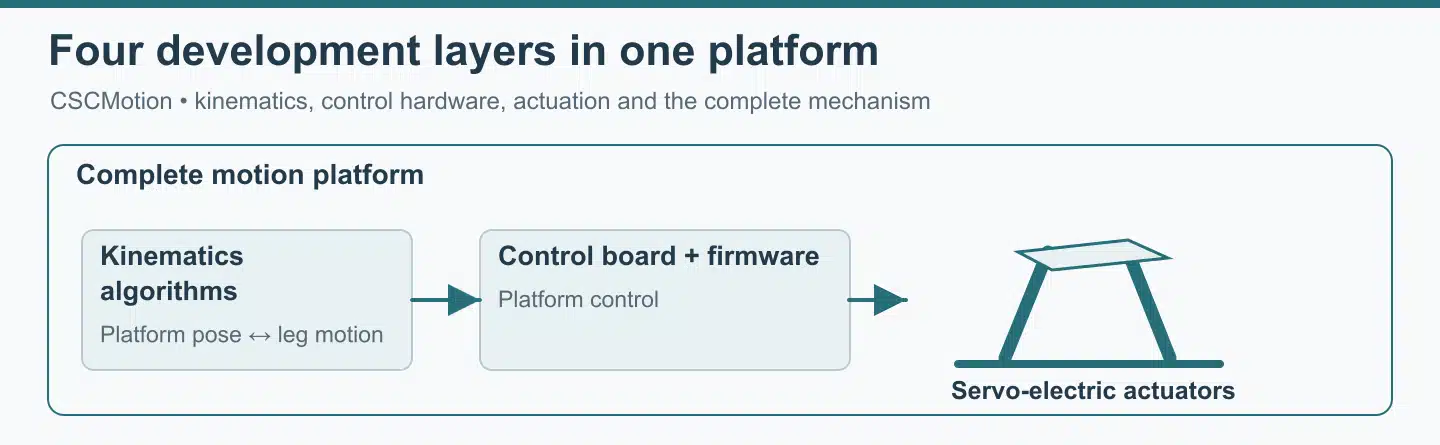
CSCmotion is based in Nanjing, China. We design and build complete electric 3DOF, 6DOF and Stewart motion platforms. Every platform is custom, engineered to your payload, motion envelope, velocity, acceleration and size requirements. The same comparison questions above can be applied to our proposed scope.
We design the mechanical structure and assemble every platform in-house. We also assemble the servo-electric actuators, build the control cabinet and develop the control software in-house. Our development scope includes the kinematics algorithms, control board and firmware, servo-electric actuators and complete platform. Every platform is commissioned and tested in our facility before shipment.
Use the custom motion platform manufacturing page and engineering capability records as starting points for questions about the scope relevant to your project.
Our platforms are driven by servo-electric actuators and supplied with a control cabinet and motion controller. An open host interface and SDK are available for host integration; the applicable documentation must define the connection for your project.
The acceptance method, test load and trajectories are agreed in the project agreement. Factory acceptance testing can be witnessed by you or a third party, on site or by remote video. Before you order, we can share a sample FAT protocol and a sample interface document. The samples support an early discussion; project conditions and acceptance decisions still need agreement.
Our management systems are certified to ISO 9001, ISO 14001 and ISO 45001. Compliance documents are agreed for each project and destination. Evaluate each motion requirement using the agreed project test method and records.
Installation and commissioning, from remote guidance to on-site work, are agreed for each project, with operation and maintenance training, remote support and spare parts supplied directly by us. The control software can be upgraded or frozen at an agreed version.
To begin, Request a Motion Platform Quote with your current requirements and open questions. Every inquiry is read by an engineer who replies within 24 hours.
FAQ
How do we compare suppliers when their scopes differ?
List the work included, excluded and awaiting confirmation in each proposal. Resolve the differences that affect configuration, host integration or acceptance before selecting a supplier. A broader package is useful only when its responsibilities match your project and the supporting evidence applies to the proposed configuration.
Does an SDK mean a platform is ready for our host system?
An SDK provides an integration starting point. Compatibility still needs review against your host software, required functions and applicable versions. Request the interface document and agree who implements and verifies the connection. CSCmotion offers an open host interface and SDK; specific behavior should be established through the project documentation rather than assumed from the SDK label.
Can we review FAT and interface samples before ordering?
CSCmotion can share a sample FAT protocol and a sample interface document before an order. Use them to discuss the proposed method and integration responsibilities. A sample is not an executed test report or an acceptance decision for your platform. The actual test load, trajectories and acceptance method are agreed in the project agreement.
Can we start an inquiry before every technical input is confirmed?
Yes. Share what you know and identify what remains open, including who can supply the missing information. Ask which gaps prevent a meaningful configuration review and which can be resolved later. CSCmotion’s engineer replies to each inquiry within 24 hours; the information needed for a completed proposal depends on the project. Keep the same updated input revision available to every candidate.
References
MIT dynamics lecture: inertia tensor and reference definitions, selected sections on mass distribution, reference points and coordinate axes.
Discuss your project with CSCmotion. Share your application, moving load and required motion for a free feasibility review and quotation.