Written by the CSCmotion Motion Control Engineering Team
Published: October 24, 2026 · Updated: October 24, 2026
Review scope: terminology, project objectives, selection inputs and CSCmotion supply responsibilities.
For six-axis parallel platforms, hexapod and Stewart platform can describe the same type of mechanism. Both names appear in motion simulation and precision positioning contexts. Compare each proposed machine against the work you need it to do.
For a useful hexapod vs Stewart platform comparison, start with the project objective. Must the mounted object follow a motion trajectory, reach an alignment position, remain at a target pose, or do several of these? A project may have requirements both during movement and after arrival.
Start with the required result at the mounted object, then compare the conditions under which that result must be achieved. Use a defined task and supporting evidence to assess the proposed configuration.
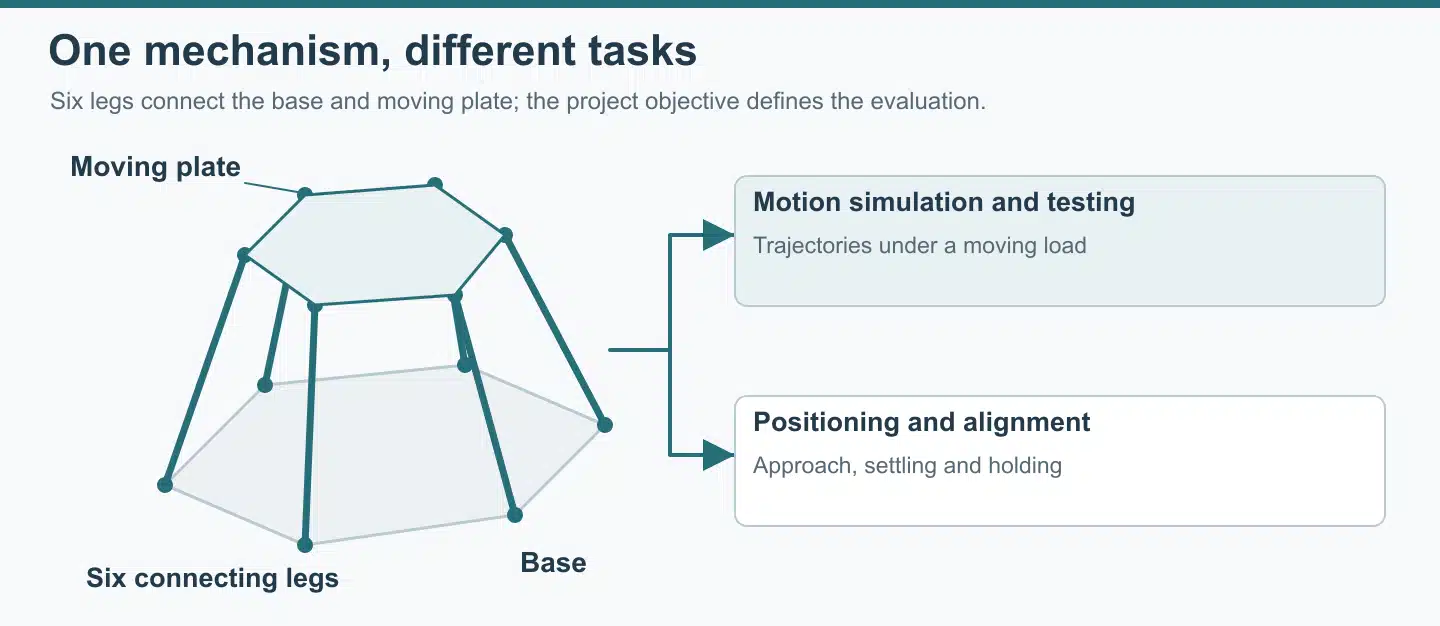
The useful distinction is between the proposed mechanisms and their intended work. Academic literature describes a flexure-jointed hexapod, also called a Stewart platform, with a moving platform connected to a base by six variable-length legs. This establishes an overlap in terminology for that parallel kinematic structure.
When a proposal says “hexapod parallel robot,” confirm that it means the parallel platform relevant to your project. The wider six-legged robot vocabulary can refer to other arrangements. Use a photograph and a mechanism drawing to identify the offered structure, then request the relevant test conditions and results.
Ask the supplier to identify the platform’s translational and rotational motions, the reference for each axis, and the limits that apply to their combination. “Six degrees of freedom” is a useful description of motion possibilities. Request the available translation, rotation and working conditions at the poses your task requires.
Keep component descriptions in their proper place. An actuator, motor or drive specification needs to be connected to the proposed mechanical assembly. Ask how leg length, joint arrangement and platform geometry relate to the requested task; do not assume that a component specification describes the complete hexapod system.
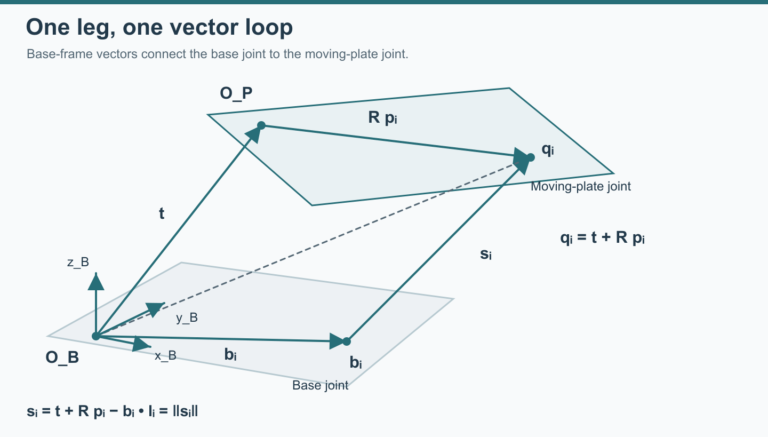
For an initial comparison, record three things beside each proposed model: the mechanism, the project objective and the evidence still needed. This avoids debating labels while leaving the actual requirement unresolved. For the pose-to-leg-length relationship and an illustrative calculation, read Stewart platform kinematics equations. Keep mathematical feasibility separate from load capacity and demonstrated behavior. Use our explanation of Stewart platform design when you need more structural detail, then return to the task and its validation conditions.
Motion Simulation Hexapods: Payload, Stroke and Dynamics
For a motion simulation project, describe what the mounted object must do over time. A motion hexapod requirement should include the intended trajectory and the conditions under which it must run, rather than stop at a desired number of axes.
Consider a hypothetical civil flight simulator or driving simulator project. The engineering team needs to describe the moving equipment, fixture and any occupant assumptions included in the payload. If the purpose is vehicle research or training, state the intended task and identify which surrounding systems belong to the integrator.
Provide the moving mass and its reference, center of gravity, mounting orientation and relevant external forces or moments together. Ask the engineering team to evaluate these conditions together. Include available inertia information and mark estimates as estimates. If a fixture is still being designed, show which dimensions and mass properties remain open.
Then explain the requested movement. Is the test stand required to follow a continuous trajectory, perform a sequence of poses, or apply a specified vibration input? State the necessary speed, acceleration and operating duration as project requirements. “High dynamic” is too broad to replace those inputs. If the motion is described as roll, pitch and yaw, define the axes and reference orientation so the control discussion starts from a shared convention.
Review stroke and travel in the same way. Do not assume that separately listed axis travels are available simultaneously; request an evaluation of your positions, rotation reference and combined trajectory. Ask the supplier to explain how actuator stroke relates to platform travel range for your trajectory, including the transition between poses.
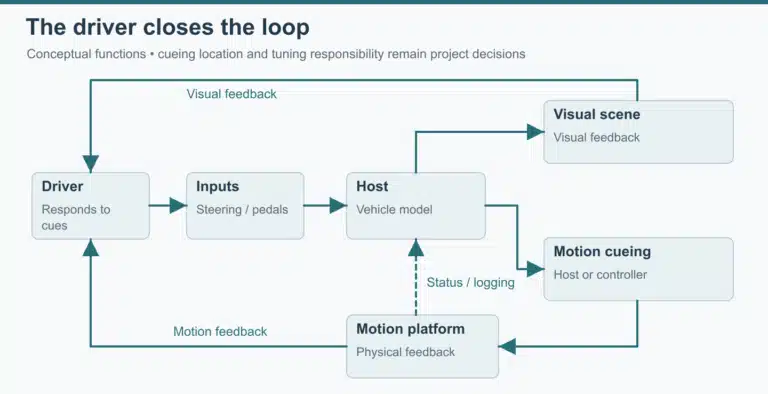
Finally, identify the source of the motion command and the information the host needs from the controller. Request the interface documentation before assuming that your motion control software and the proposed platform can work together. Our motion platforms for simulators page describes the application context; the specific motion, load and integration requirements still need review.
Precision Positioning Hexapods: Alignment and Holding Tasks
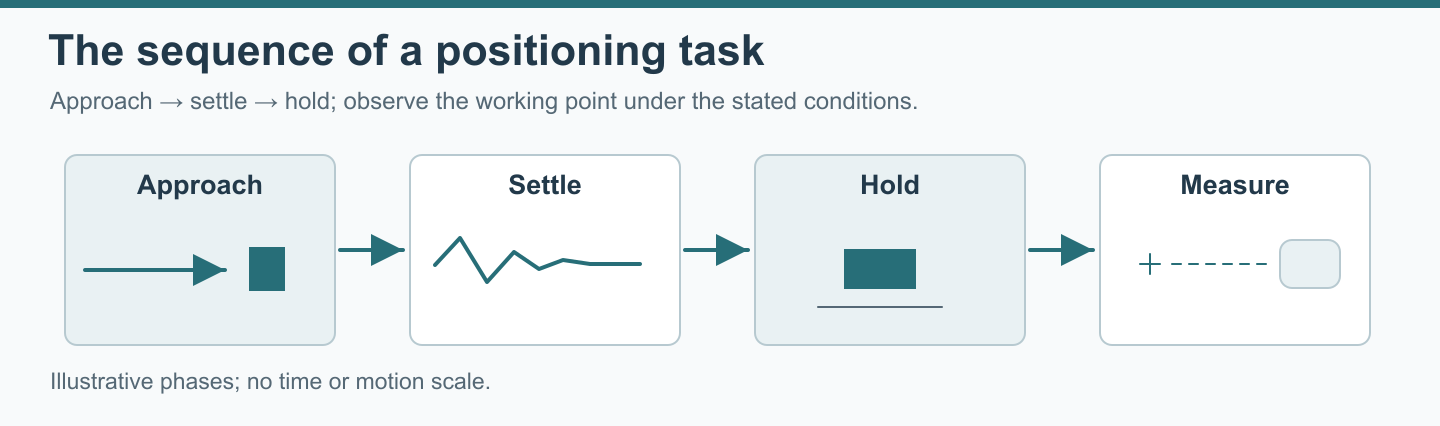
For a precision positioning task, start with the result needed at the working object. A hexapod stage or hexapod positioner description should lead to questions about the target pose, the working point and how the result will be demonstrated.
As a hypothetical example, a laboratory team may need to place a mirror in alignment before an optical measurement begins. Ask where the relevant point in space lies, which position and tilt must be controlled, and what the instrument must do after arrival. If a pivot point is specified, show it on the drawing with the coordinate reference. Do not leave the supplier to infer it from the outline of the fixture.
Define the sequence as well as the destination. Does the task require a move, a settling interval, a hold period and then another move? Is the movement itself part of the measurement? A positioning task can include a specified approach trajectory as well as a hold at the target pose. The two sets of requirements can coexist.
Ask the person responsible for metrology to define the measurement conditions and the observable result required. For stability during a hold, specify the duration and relevant environment in the request. If stiffness matters to the process, ask what evidence should be supplied under the proposed loading conditions.
An optics research task and a manufacturing alignment task may use similar vocabulary while needing different evidence. Even “high-precision” needs a project-specific definition. Whether the proposal uses a multi-axis platform or includes a linear stage elsewhere in the assembly, write the requirement at the working object and identify who will verify it. Carry that description into the comparison below.
Side-by-Side: Requirements to Compare for Your Project
Compare the same project conditions across proposals. Motion over time and behavior at a target pose may both matter. Keep both requirements visible when the application includes movement, settling and holding.
Scroll horizontally to view all columns →
| Requirement | If motion over time is the main task | If positioning or holding is the main task | Information to compare |
|---|---|---|---|
| Project objective | What motion must the installed object follow, and for what test or simulation purpose? | What must the object achieve at the target pose, and what happens next? | A task description that includes every relevant phase. |
| Moving load and mounting | What moves with the platform throughout the trajectory? | What is attached during approach, alignment and holding? | Load and fixture drawings, mass, center of gravity, inertia inputs, mounting direction and external force or torque assumptions. |
| Workspace and reference point | Which translations and rotations must occur together? | Which working point, orientation and approach path matter? | A common coordinate system, reference position and actual combination of poses; the conditions behind catalog limits. |
| Motion over time | What speed, acceleration, trajectory and repeated running period are required? | What movement occurs before, between or during the working tasks? | Time-based requirements and the proposed method for checking them. |
| Positioning or holding task | What must happen at pauses or endpoints within the sequence? | What must be demonstrated at the working object after arrival? | Target definitions, hold duration, measurement responsibilities and required evidence. |
| Duration and operating context | What running schedule and environmental conditions apply? | What conditions apply during the measurement or hold interval? | The operating sequence, duty cycle request and relevant site constraints. |
| Host integration | Where do motion commands originate, and what information must return? | How are positioning requests and completion conditions exchanged? | Interface documents, software responsibilities and unresolved integration questions. |
| Acceptance evidence | Which motion sequence must be demonstrated under the agreed load? | Which arrival and holding tasks must be demonstrated, and how? | An agreed method, test load, trajectories, observations and records. |
Keep physical constraints beside the table. For example, show the available installation size, a vertical or other mounting orientation, and the cable route that needs review. If the task involves vacuum conditions or a magnetic field, identify that requirement explicitly and ask the supplier to confirm its relevance and feasibility.
When a datasheet gives a linear travel range or an angle, ask what reference and loading conditions apply. Request clarification of any relevant joint angle or individual strut limit for the proposed combined motion. If the drawing uses Cartesian coordinates, retain the same convention in the comparison; a coordinate system should not change silently between documents.
For every proposed configuration, ask the supplier to explain any trade-off and the evidence supporting it. Record unresolved electrical requirements, software complexity or an error definition as open questions, rather than filling the gaps with assumptions. At CSCmotion, the acceptance method, test load and trajectories are agreed in the project agreement.
Which One Is Your Project? A Five-Question Check
Use these questions to prepare a short project summary. Use the answers to identify the requirements and assumptions that need engineering review.
1. What must the mounted object do? Describe the task as an action: follow a motion sequence, reach an alignment pose, hold while an instrument takes a measurement, or perform a combination. Name the object and its fixture. If the request currently says only “6DOF hexapod,” add the intended result before requesting a model recommendation.
2. What must be demonstrated during motion and after arrival? Write two separate lines, even when one is marked “not yet defined.” For the movement phase, identify the trajectory or sequence that matters. For the arrival phase, describe the work to be performed and what evidence would show that the requirement has been met. Do not replace an unknown acceptance condition with a familiar catalog adjective.
3. Under which load and workspace conditions? Attach the available load and fixture information, center of gravity, inertia assumptions, installation orientation and combined movement requirements. Include the running schedule and any relevant environmental constraint. Label the drawing revision and identify data still expected from another project team. This gives the supplier a concrete basis for questions instead of an apparently complete but uncertain load case.
4. How will the host and platform work together? Identify the existing host system, the intended command source and the feedback information the integration team needs. Ask who supplies and reviews each interface document. For a CSCmotion platform, the published scope includes an open host interface and SDK; the detailed connection still requires review. Confirm command definitions and feedback with the interface document before selecting the host connection.
5. Which requirements are documented, and which still need review? Mark each requirement as documented, provisional or missing, and assign an owner to resolve it. Then choose the next discussion. A motion-platform purchasing task can move to the relevant product team with the load case attached. A clearly defined micron-level precision positioning task needs a supplier that offers that scope. A mixed or unclear task needs both sets of requirements reviewed together.
For a mixed project, do not discard the holding requirement to fit a motion-platform description, or discard the motion requirement to fit a positioner description. Ask the engineering team to confirm which conditions it can assess and what information is missing.
Before sending that summary, check your inputs before you request a quote. Attach the completed inputs to your inquiry so that the main task and required evidence remain connected.
What We Build, and What We Don’t

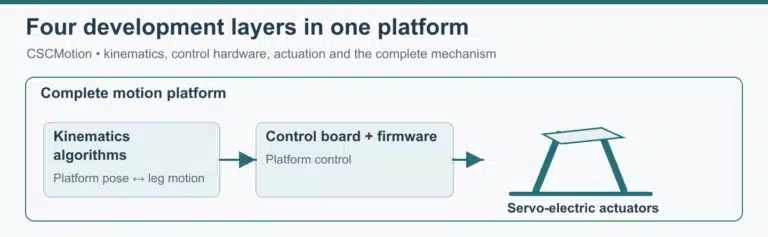
CSCmotion designs and builds complete electric 3DOF, 6DOF and Stewart motion platforms. The platforms are driven by servo-electric actuators, and a control cabinet and motion controller are supplied with the platform. Our scope includes an open host interface and SDK. Every platform is custom, designed around the customer’s load, stroke, speed and acceleration requirements.
We do not build micron-level precision positioning hexapods. When a project combines different objectives, describe both and ask for a review of the actual requirements.
For a motion simulation project, see our electric Stewart platforms for motion simulation. Our 6DOF motion platforms page provides the related product entry point. Use those pages to understand the platform scope, then submit the load and motion requirements for your particular installation.
The acceptance method, test load and trajectories are agreed in the project agreement. Use those project requirements to agree the configuration and the demonstration needed for your task.
Not sure which requirements apply? Send your load case with the task description, available drawings and the questions still open. Include movement and holding requirements together when both matter, so the initial review addresses the project you actually need to deliver.
FAQ
Are a hexapod and a Stewart platform the same thing?
For six-axis parallel platforms, the terms can refer to the same type of mechanism. An academic description uses both names for its six-legged platform. Confirm the structure and intended task in the supplier’s documentation.
Does six degrees of freedom mean two platforms are interchangeable?
Evaluate each platform against your load, combined workspace, motion sequence and working task. Compare the proposals using the same drawings and requirements, and ask what evidence supports each answer. If one proposal leaves a condition unresolved, retain that gap instead of treating its six-axis description as confirmation.
Can payload alone distinguish a motion hexapod from a precision positioner?
Evaluate payload together with the motion and positioning requirements. Ask suppliers to evaluate the load together with its mounting and operating conditions. Then compare what the platform must demonstrate during motion and at the target pose. Compare the operating conditions and evaluation method for each proposed configuration.
What if my project needs both motion and holding?
Document both phases and identify which result must be checked in each. Include the transition between them, the relevant load and the operating duration. Keep the combined requirement visible during supplier review; do not assume a platform supports the whole sequence because one phase appears in its product description. Ask which part still needs evidence or clarification.
Does CSCmotion build precision positioning hexapods?
We do not build micron-level precision positioning hexapods. We design and build complete electric 3DOF, 6DOF and Stewart motion platforms. If your project combines motion with a positioning or holding task, explain both requirements for review.
References
Academic paper: Identification and Decoupling Control of Flexure Jointed Hexapods, Figure 1 and the opening of Section 2, for the overlap in names and the described structure.
Discuss your project with CSCmotion. Share your application, moving load and required motion for a free feasibility review and quotation.